
Software for the Global Actuary of Tomorrow: In Conversation with RNA Analytics
At the TASK 11th Annual Convention in Mombasa, TASK President Lorraine Njue sat down with Anton Clennar of RNA Analytics to talk about where actuarial modelling software came from, where it is going, and why the actuary stays at the centre of it all.
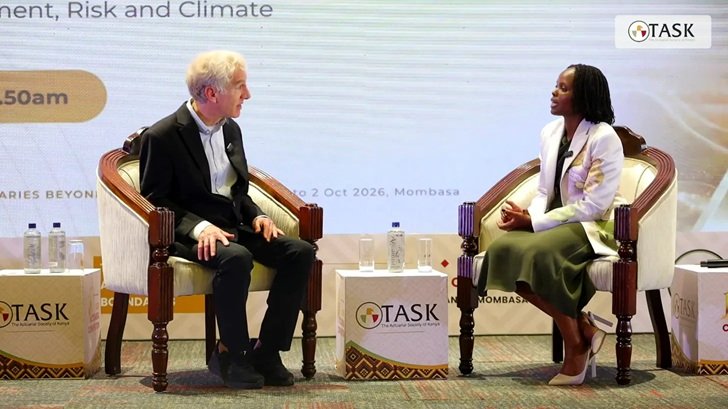
Anton Clennar (RNA Analytics) and Lorraine Njue (President, TASK) at the TASK 11th Annual Convention, Sarova Whitesands, Mombasa.
RNA Analytics has supported The Actuarial Society of Kenya (TASK) for the past three years, and this year we wanted to get to know our partners a little better. Recorded at Sarova Whitesands, Mombasa, this short conversation covers nearly three decades of modelling software history, a growing AI programme, and what the platform can offer actuaries in Kenya and beyond.
From a 1997 desktop tool to a global platform
Like most people in the profession, Anton started out studying actuarial science. It was in his first actuarial role that he was exposed to modelling software, and the interest stuck. When he later joined Willis Towers Watson, he had the chance to help design the software that RNA Analytics sells today.
The platform began life in 1997 as the valuation system Willis Towers Watson used for its global clients' valuation and capital modelling. That year a decision was taken to turn it into a desktop software solution, and Anton was involved in its architecture. From the start, it was designed with asset-liability modelling in mind, so that it could run sophisticated calculations in a very memory-efficient way.
After Willis Towers Watson also acquired the MoSeS software, European competition rules meant it could keep only one of the two products. It kept MoSeS, and this software was sold on, eventually being bought by Korean entrepreneur Harry Kim, who expanded it across Asia.
Today the numbers speak for themselves:
80% of the Japanese market
40 countries
100+ large insurance companies
2,000+ users
What started on the desktop now runs on cloud servers, which lets it cope with very large volumes of records in a robust, scalable way. That scalability is a big part of why it has been adopted so widely in Japan.

AI that empowers the actuary, not replaces them
Asked what users can look forward to next, Anton's answer was simple: "It's all about AI now."
For the past two years RNA Analytics has been running an AI programme aimed at making modelling better for actuaries. "We don't want to replace the actuary," he explained. "We want to empower them." The goal is to make the software side of modelling easier, to the point where you can almost communicate with the software in plain English and have it build the models you want.
The actuary still needs the mathematical expertise to understand what the model is doing, and the platform is built to support exactly that. Rather than producing black boxes, as much of today's AI does, it generates transparent, explainable models that are fully visible inside the software. Actuaries can see what has been built, understand it, improve it, and create models quickly that are genuinely useful for their customers.

Beyond Excel: what the software actually does
For students and younger TASK members wondering what a dedicated modelling platform offers beyond Excel, Anton started with the fundamentals. At its core, the software creates cash flows. On top of that, it handles reserving and capital calculations across the world's major regulatory regimes, including:
IFRS 17
Solvency II
J-ICS in Japan
K-ICS in Korea
LDTI and VM-22 in the United States
The result is the ability to build models quickly, and to build models that fit the regulation in your country. "I really believe it's a model suited for global actuaries," Anton said, "like most of our members are."